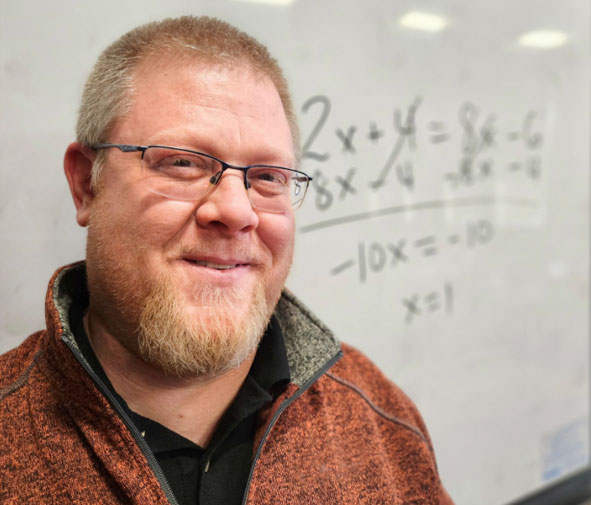
Musante of Ludlow is on track to graduate in December with a master’s degree in education through the Center for Equity in Urban Education (CEUE) at Elms College. Until he enrolled in the program, he had never taken any education classes.
I’ve been a teacher in Springfield for 13 years, the last 8 years at John Jay Duggan Academy for Social Justice, which is a magnet school in Springfield within the Springfield Empowerment Zone Partnership. I teach 8th grade math. I didn’t plan on becoming a teacher; teaching was kind of a backup plan for me. Before teaching, I was a quality control foreman for the electric company, but they cut the entire department and I was laid off. I was on unemployment, I did construction, and I even did two stints with the last U.S. Census. A friend said I should try substitute teaching at his school because they need subs every day and it would be consistent pay. And I said “Let’s do it. I need to do something.”
I liked subbing. I enjoyed it. I was a high school baseball coach for a long time, so it was just a natural fit for me to become a teacher and work with kids. I was always good at math, and my mother who is a teacher said I should take the MTEL (Massachusetts Exam for Teacher Licensure) and become a math teacher. I studied on my own and took the exam for mathematics and passed it, earning my provisional license to teach. To advance to a professional teaching license, I needed to complete a master’s degree program. That’s how I found CEUE. Until I enrolled, I had never taken any education classes before.
The CEUE has been an excellent experience because its emphasis on equity in education is very much in alignment with what we are trying to do at Duggan. Some of the things I’ve learned at Elms have helped me in my professional life, including equity in the classroom, making learning accessible for all students, and employing culturally responsive practices in what I teach.
What that means in my case is I’m not just teaching math, but teaching math in ways that the students can relate to it. I have to learn about my students and figure out ways to connect what we’re doing in the classroom with what they have going on in their lives. For example, in studying geometric transformations and rotations, I equated it to how characters move in 3D video games. If you rotate a triangle 90 degrees clockwise along a plain, it is the same movement as when you turn to the right in Minecraft. You tell your character to move to the right, but the computer program is saying 90 degrees clockwise moves that character to the right.
Or when I teach about linear equations, proportionality, and rates of change, I have the kids start a sneaker business. A real thing with kids these days is the buying and selling of sneakers in the aftermarket because they’re collectible and their value goes up. So they identify the initial costs, but also learn things like the constant of proportionality which is the rate of change. They figure out how much to charge for their sneakers by relating it to being profitable or making money versus losing money.
It’s not always easy. I can walk into any classroom and teach math. But to make it connect to the students – so that they get it and can relate with it to the point where they’re like “Oh, yes. I understand this!” – that is hard. Sometimes students will make an actual connection, and you’ll see the lightbulb go on and they’ll be thinking “I see how this works now!” It’s very gratifying; I just have to figure out how to get the lightbulbs to go on more.
All of this is new. When I first started, I was very firm in how I taught. I was of the mind that there was just one way to learn math. “This is how I learned it, and now you are going to have to learn it this way too.” From my work in CEUE, I’ve learned that teaching has progressed to a point where that is not true anymore. If a student can show their thinking in a different way than maybe from the way I teach it, then what is wrong with that? If they understand it and can demonstrate the knowledge, what’s wrong with thinking differently, or demonstrating the knowledge in a different way?
CEUE turned out to be such a good fit for me. It has made me a better teacher. I really believe that it has.
To learn more about the Cynthia E. Lyons Center for Equity in Urban Education or how to register, go to the department homepage at https://www.elms.edu/ceue/