Rediscovering joy after loss through nature: Elms senior publishes book of poetry
The Geese
(For Mary Oliver)
By Adam Sarlan
“The World offers itself
to your imagination,
calls to you like
the wild geese”
Mary Oliver said to me
one morning while I sat
on the shore; that night
as I walked through
the Provincelands
I saw the geese
lying along the path,
(for how long they were
there I do not know)
And when I looked into their
glossy, pine colored pupils
I knew that they knew
and for the next hour
I told them of my misery;
when I finished, I asked:
Oh what, what do I do
with myself?
Nothing. You must learn
to live with yourself and create
amidst the weeds
and the muck of life.
That is what it means
to swim in our pond,
they said to me.
**Punctuation, capitalization, and spacing are as written by the author
Elms College student Adam Sarlan learned throughout his life to be attuned to the natural world. His family always encouraged him to be outside, observing nature. They even arranged weekly family outings each Sunday in wilderness preserves and state parks.
When his father and uncle each died a few weeks apart a little over a year ago, Adam, a senior majoring in English and Education, looked to nature to help process his sense of loss and unending grief.
“It was a tough time,” he said.
He said that by processing his grief through his three interests of nature, poetry and creative writing, he was able to feel joy again. His healing process involved spending hours in the wild watching birds in their natural habitats and then coming home to write poetry about what he saw and learned.
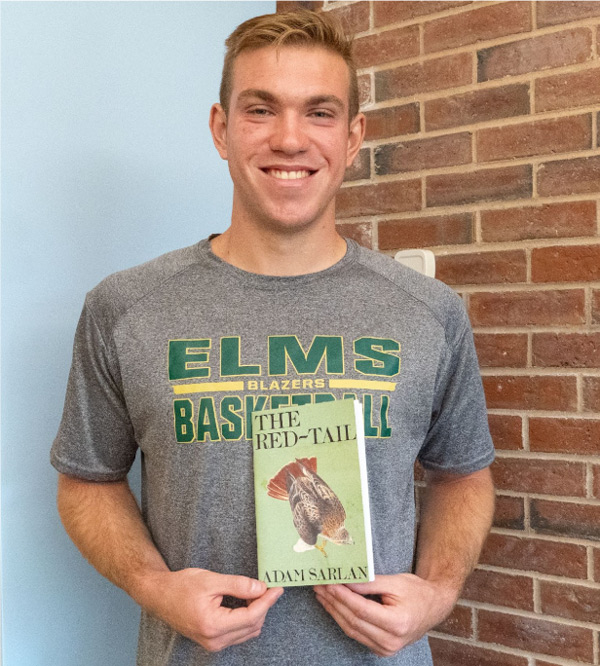
The collection of poems are published in his first book of poetry, titled “The Red-Tail,” published recently by Bottlecap Press of Los Angeles.
“I would like to think of this book as kind of a road map on how to live a simple and glorious life,” Adam said.
Although it originated in a dark place, Adam said, the work ultimately became “a pathway for how to begin life again after grief.” The collection is published as a chapbook, which is a pamphlet-sized publication that is smaller and less expensive than a conventionally sized book. The work includes 20 poems over just 30 pages. It is available for $10 through the Bottlecap Press website, https://bottlecap.press. Copies may also be found locally at Amherst Books in Amherst, Broadside Books in Northampton and Book Moon in Easthampton.
The chapbook may be small, but the ideas on grief and recovery expressed through his poetry are quite large.
Seventeen of the poems are inspired by birds, including robins, great blue herons, Northern cardinals, cormorants, and geese, just to name a few. He describes hearing joyful trilling of cardinals, bluejays, and cowbirds around the feeder each morning and feeling himself come alive. He writes of swans gliding across the surface of still ponds like white angels, and of being taught the meaning of patience by a great blue heron standing still as a statue as it hunts for lunch.
From the birds, he learned to see them living each moment with a quiet grace and resolve, always moving forward, and not getting bogged down by any painful past. That, he said, is ultimately the lesson learned.
“What really reflected and encapsulated my whole view about nature is finding the good in the simple moments, finding good in your life,” he said.
The collection of poetry came about as his way of seeking to offer a hand up to others who are feeling knocked down by life, he said. “It’s me saying you’re not alone out there, you can learn how to live with yourself and live a new life again by learning from nature.”
Through the poems, he imagines conversations with the birds, where they impart their wisdom and varying lessons for survival. The one thing the birds do not do, he said, is offer much sympathy or any feathery shoulders to cry on. For example, in his poem, “The Poet Cries at Sunset,” a rather snarky herring gull tells Adam,
“If you’re going to cry,
cry already,
this world needs more
sadness anyway.”
In another poem, “The Geese,” Adam talks of sharing his troubles with a flock of geese by a pond for an hour or more. When he asks the geese how they are able to carry on through times of sadness, they tell him that the secret is there is no secret.
“… You must learn
to live with yourself and create
amidst the weeds
and the muck of life.
That is what it means
to swim in our pond.”
“The Geese,” he said, is inspired by the famed Mary Oliver poem “Wild Geese,” which is also about sorting out feelings of loss, despair, and forgiveness while the natural world keeps on moving. Adam said Oliver and James Tate are among his favorite poets, and he is inspired by how their work connects with the natural world.
He credits the members of the Elms English Department faculty for encouraging him through the four months it took to compile and edit the book, and for inspiring his love of poetry and creative writing.
“Before I came to Elms, I didn’t write. I didn’t know how to express myself,” he said. “My professors at Elms really gave me the grace and allowed me to find myself. They allowed me and encouraged me to get out there, and to write and to see something in myself that I didn’t see. I am absolutely thankful for them helping me get out of my shell.”
He said after graduation, he plans to go to graduate school and then would like to teach creative writing at the high school level. There is too much emphasis in education these days on expository or essay writing, he said. “Creative writing is a legitimate outlet, where people can express their observations and innermost emotions and feelings,” he said.