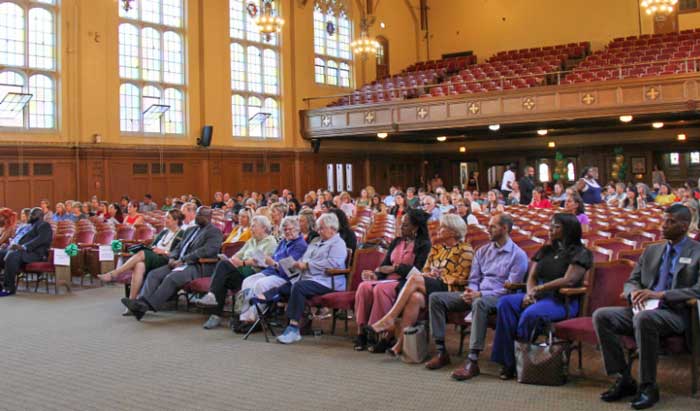
Elms College had the great honor of hosting a community town hall Sept. 14 in Veritas Auditorium on a subject that we at the college consider to be critically important: knowing how to read. That the event was attended by leaders from colleges and secondary school systems through greater Springfield and more than 100 members of the general public shows they feel the same about literacy.
Read more: Western Mass. Literacy Collaborative: community solutions needed for a growing problem affecting our children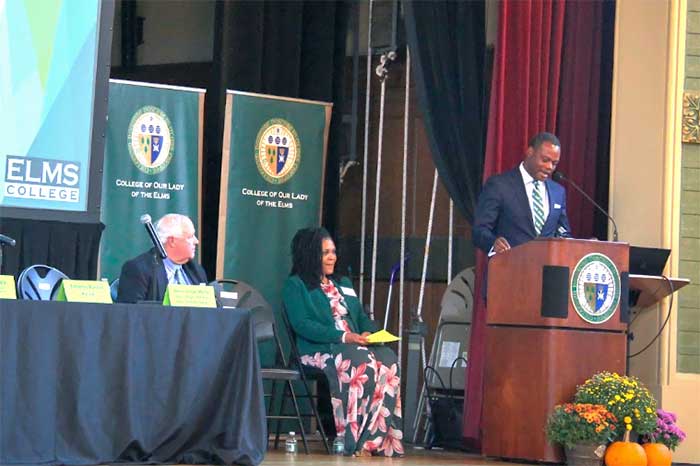
The town hall was a part of the Western Massachusetts Literacy Collaborative, a new partnership that emphasizes both the importance of reading in our society and that the best solutions to any problem are found when we all work together.
The literacy collaborative was founded this spring in response to a devastating national study by the National Assessment of Educational Progress, also known as the Nation’s Report Card, that showed school children across the United States, regardless of geographical areas, are not reading with the same proficiency as those from decades earlier. Test results showed declines in reading scores at urban, suburban, and rural schools not seen since the 1990s.
There are times when a community approach to a shared problem is warranted, and from that emerged the Western Massachusetts Literacy Collaborative. From its launch, it was endorsed by the presidents of the Colleges and Universities of Greater Springfield, by Springfield Public Schools Superintendent Daniel Warwick, and the Springfield Empowerment Zone. It also received encouragement from the Western Massachusetts Economic Development Council and generous support from the Nellie Mae Foundation and the Irene E. and George A. Davis Foundation.
The Western Massachusetts Literacy Collaborative springs from an idea from Elm College Trustee Emerita, Cynthia Lyons. She is the former chair of the Board of Trustees, the namesake of the Cynthia A. Lyons Center for Equity in Urban Education (CEUE), and a fierce advocate for education in general and literacy in particular.
This past summer, the collaborative launched the Learn and Earn Literacy Corps, where college students seeking degrees in education were trained as literacy interventionists by faculty with CEUE and then deployed to teach in Springfield public schools during summer school. A total of 15 students from Elms College, AIC, Westfield State, and Bay Path participated this summer. Results have been glowing and we are encouraged to and looking forward to expanding efforts to Chicopee Public Schools and catholic schools in the Diocese of Springfield.
I am sharing below excerpts from my remarks at the event:
Many of us can remember a book that had an important impact on our lives and how it shaped the way that we think. Some of us may even remember some of the best opening lines in American – or all of- literature. Like “I, too, sing America”, the opening line of Langston Hughes’s landmark poem on being a Black man in America.
Or Tolstoy’s famous opening of the novel Anna Karenina: “All happy families are alike; each unhappy family is unhappy in its own way.”
I remember spending a lot of summer mornings at the school run by the Brothers of Christian Education in my hometown of Ouanaminthe, reading book after book and obtaining a window into the wider world.
It seems fitting to begin with these reminiscences, on this occasion where we celebrate the joy of reading, the power of collaboration, and the promise for all children in the Greater Springfield area. Most of us have spent much of our career and our life, in the company of people who love to read. College campuses are packed with people who see reading as an invaluable skill. It is necessary for our unique mission: the creation, acquisition, and transmission of knowledge. Reading can also be a means of recreation and relaxation. And it can open our horizons to worlds far beyond what our eyes can see. In that regard, it may be easy to take basic literacy skills for granted.
That is until we read reports like the National Assessment of Educational Progress, until we speak with people, like John Davis, who has been a champion for reading for a long time, or until we come across the stories of lives changed and opportunities lost because of the inability to read and learn. When we dig deeper into the statistics, we find that according to the U.S. Department of Education, 20% of American adults – one in five – lack basic English literacy skills. As a result, they cannot cannot “understand, evaluate, use and engage with written texts to participate in society.”
For a country as large as the United States, one in five translates into 43 million people. Forty-three million people are adrift and uninvolved in the affairs of their communities and have limited means of advancing their careers or standard of living. All because they have limited reading skills.
We can all agree that the best and most sustainable long-term strategy to increase literacy rates among adults is to reach out and make a lasting impact when they are children. We can also agree that while our efforts here may not so much as make a dent nationally, we can by working collectively and collaboratively have a great impact here – in the Greater Springfield Area and the Pioneer Valley. And that is where the Western Massachusetts Literacy Collaborative comes into play.
That is where all of us can do our part. It is important to celebrate the work of those who have made the Western Massachusetts Literacy Collaborative and the Learn and Earn Reading Corp a success. But it is also important that we join with them in this call to action. We must move forward to sustain and expand this effort to guarantee that all children and young people around us have the same right to read that we adults enjoy.
Throughout Greater Springfield, throughout Springfield, and the surrounding area, people have a great affinity for native son Theodor Geisel, better known to generations of readers as Dr. Seuss. It was he who years ago summed up perfectly an answer to the question of why is it important to know how to read:
“The more that you read, the more things you will know. The more that you learn, the more places you’ll go.”
There is much to do but we must work together to get it done.